















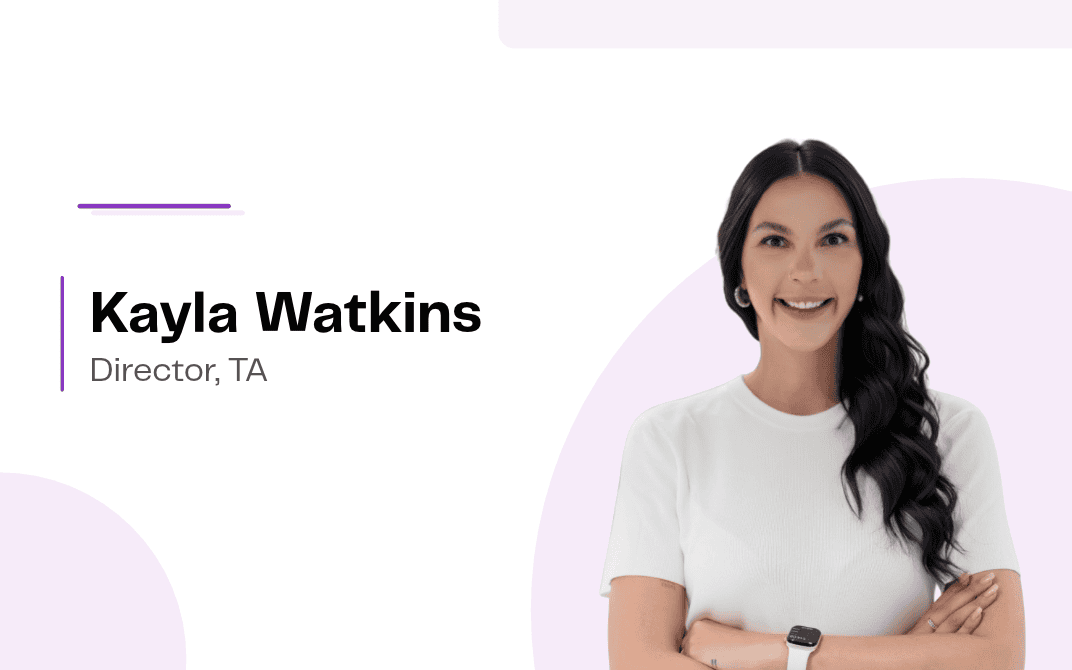
“Skima AI makes the hiring process more collaborative by giving hiring managers a clear breakdown of each candidate’s pros and cons.”

Kayla Watkins
Director, Talent Acquisition · SambaSafety

Skima AI detects resume fraud, fake interviews, deepfakes, identity fraud, AI-generated resumes, and fake applications. Automatically identifying and preventing candidate fraud before it costs you revenue, reputation, and security.


Skima AI screens every application, resume, and interview for these seven fraud patterns before a candidate reaches your team.
In a proxy interview, someone else takes the call on the candidate's behalf. In interview cheating, the actual candidate uses undisclosed AI tools, hidden notes, or a second screen. Skima AI’s interview fraud detection flags both by analyzing lip-sync, gaze patterns, response latency, and device fingerprints.
Candidates exaggerate titles, tenure, or scope, or submit resumes that contradict LinkedIn, prior applications, or their own claims. The built-in resume fraud detection cross-references every claim against available data and flags contradictions, implausible progressions, and inflated responsibilities.
Candidates list tools, frameworks, or certifications they've never used in a real project. Skima AI cross-checks claimed skills against project history, portfolio evidence, and demonstrated depth. Gaps between claimed and evidenced proficiency are flagged before the candidate reaches a technical interview.
The application fraud detection in Skima AI inspects the underlying file structure of every resume, not just the rendered text. This catches white-fonted keywords, invisible text blocks, irrelevant term stuffing, and keyword-density patterns that signal fake applications engineered to game your ATS screening rather than represent a real candidate.
Generative AI lets candidates fabricate entire work histories, invent projects, and produce polished resumes with no real experience behind them. Skima AI analyzes linguistic patterns, writing-style consistency, file metadata, and submission behavior to detect resume fraud at the point of fabrication.
Virtual cameras, injected video feeds, and face-swap artifacts are identified in real time during live interview sessions. Audio-visual inconsistencies and signs of pre-recorded or manipulated footage are flagged before the interview concludes and the candidate advances.
Stolen identities, synthetic identities, and fabricated personas are caught through document authentication, selfie matching, device fingerprinting, and IP intelligence. Fake candidates applying to jobs are flagged when their identity data doesn’t resolve to a real individual.

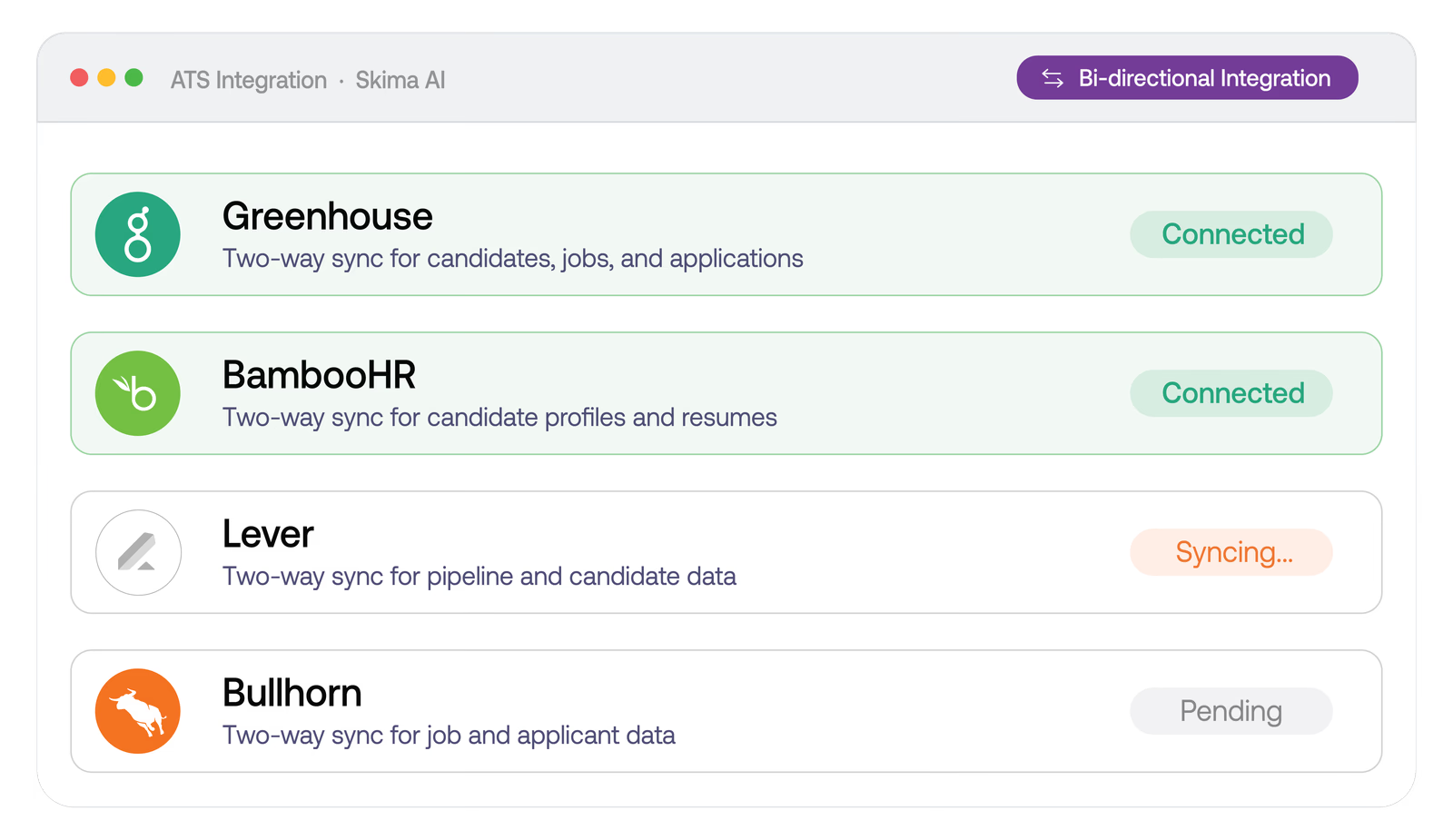
Skima AI syncs with your applicant tracking system through bi-directional integration. Candidate profiles, resumes, and application data flow into a unified screening layer. No migration or workflow disruption. Deployment mostly takes 48 hours.
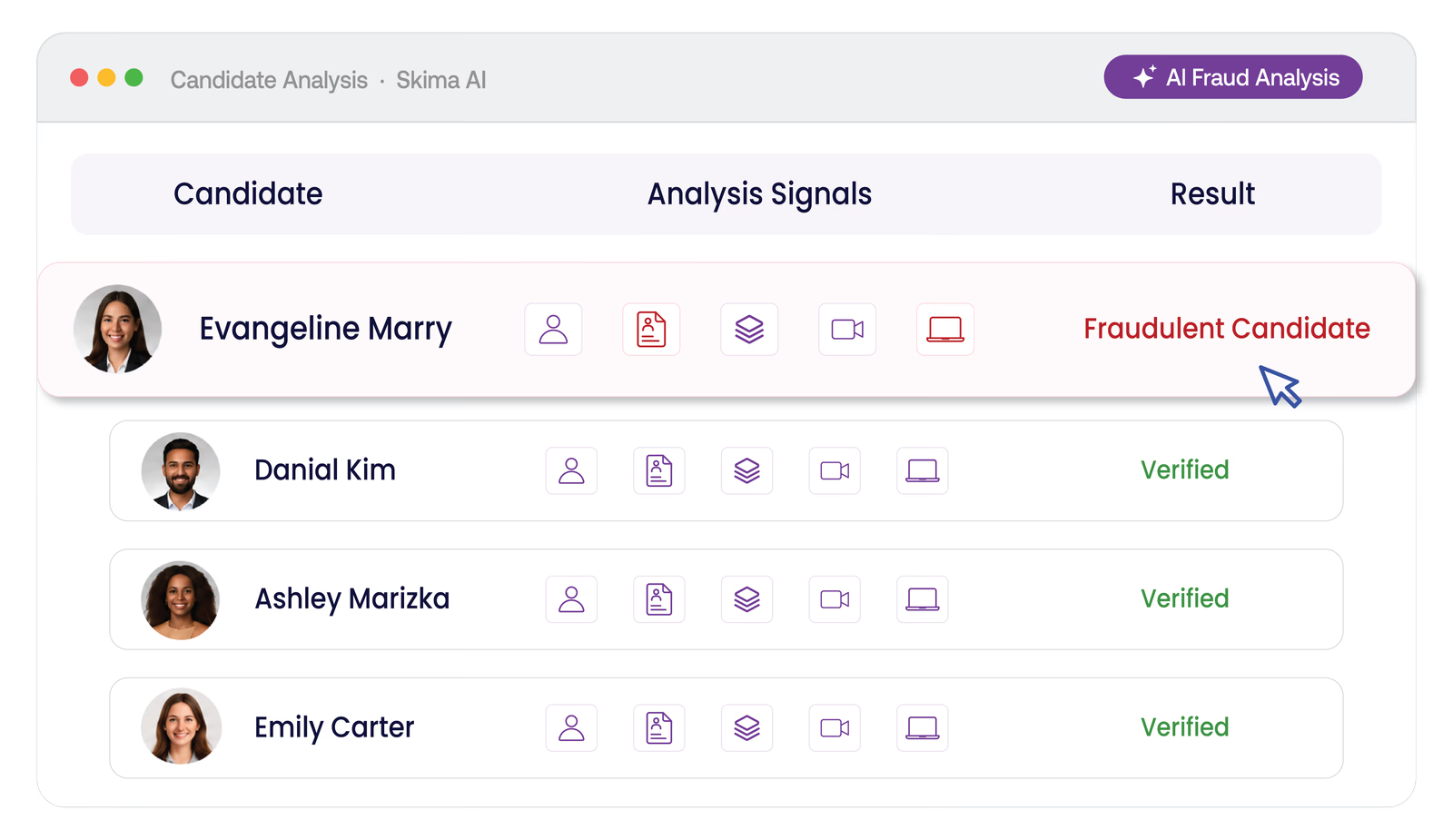
The moment a candidate enters your pipeline through application, referral, sourcing, or database rediscovery, Skima AI performs a multi-signal fraud analysis. It evaluates identity markers, resume authorship and consistency, claimed skills, interview behavior, and device fingerprints. Fraudulent candidates are flagged before recruiters spend a minute on them.
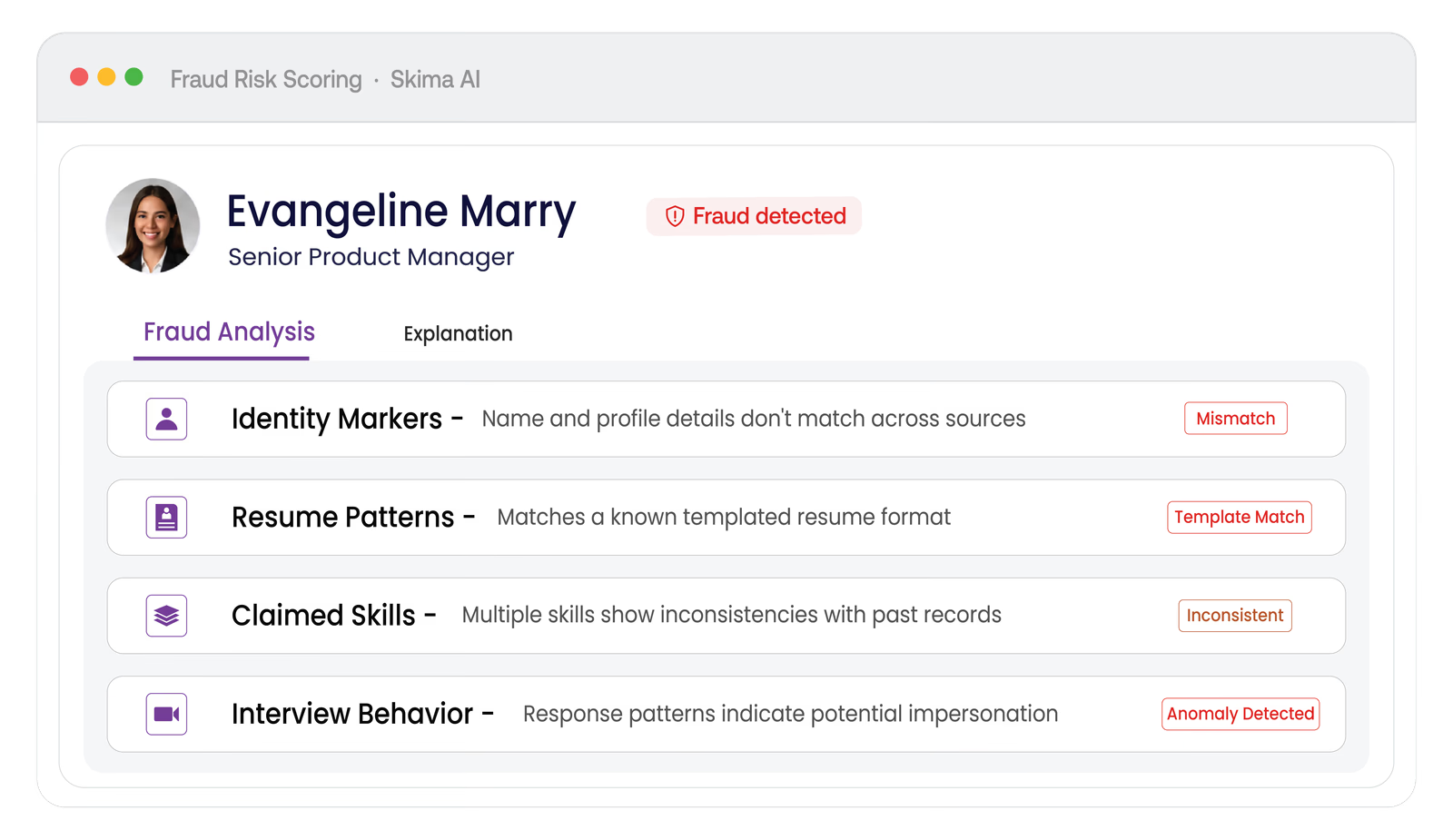
Each candidate receives a fraud risk assessment. Every flag includes the specific signals that triggered it, which identity markers conflicted, which resume patterns matched known fraud templates, and which behavioral anomalies were detected. This is what identifying candidate fraud looks like at scale. No black-box scores, every result explainable.
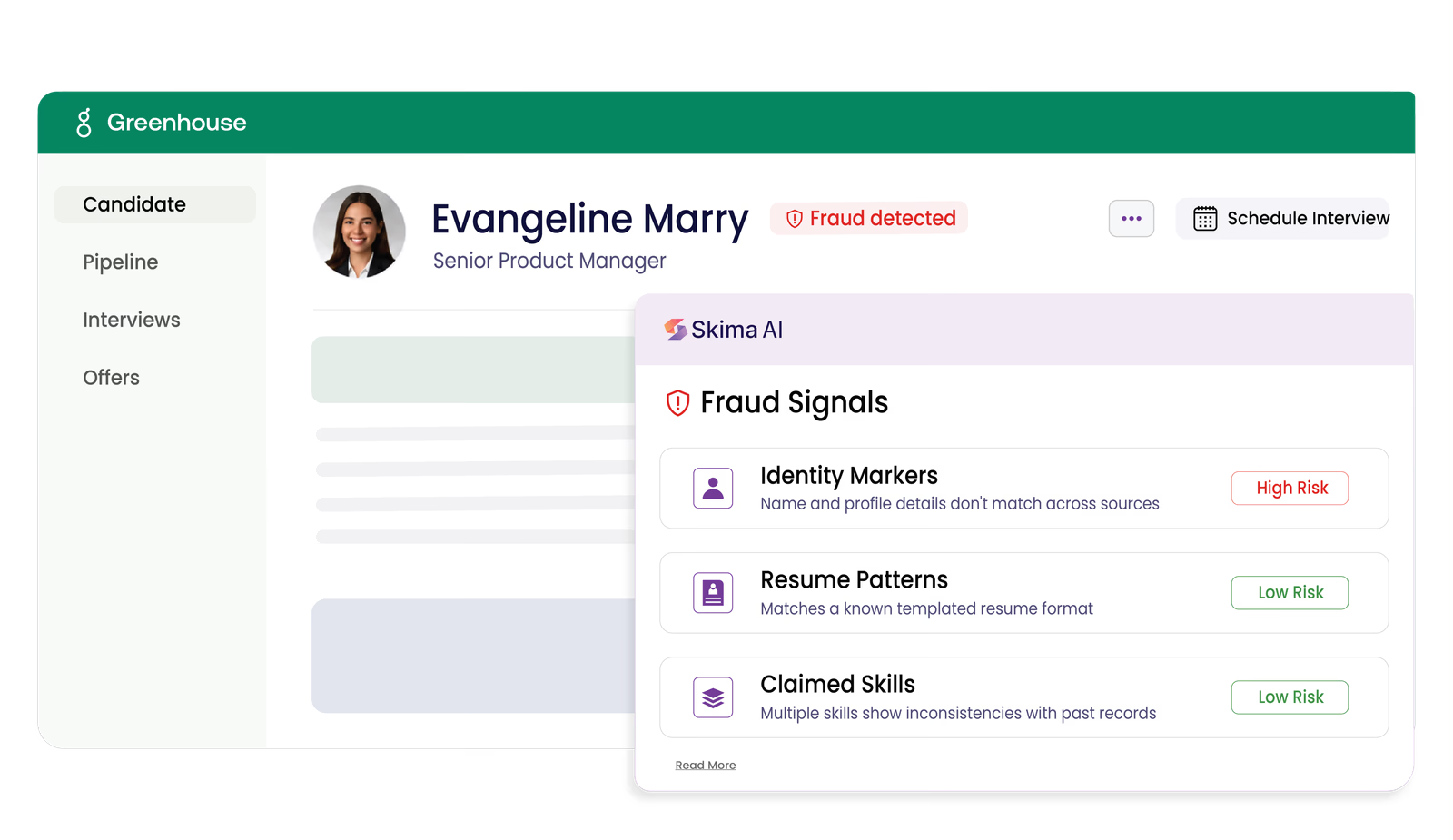
Fraud flags appear directly inside your existing recruiter workflow. No separate dashboard to check, no second tool to learn. Recruiters see the risk level and the evidence alongside the candidate's profile, right where they already work.
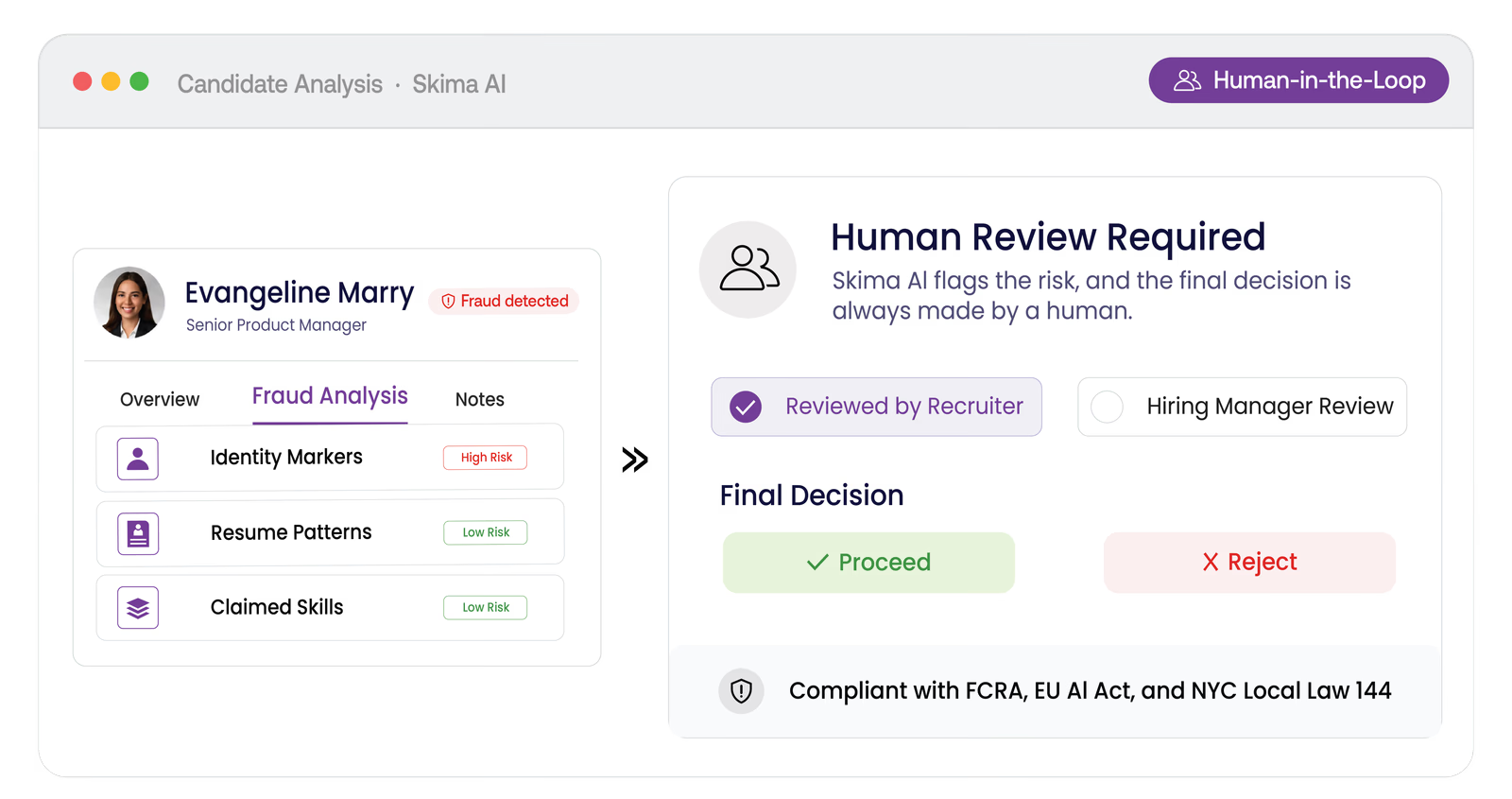
Skima AI flags candidates for human review. It never auto-rejects. The recruiter or hiring manager makes the final decision with full context. This is not a design shortcut. It is a compliance requirement under FCRA, EU AI Act, and NYC Local Law 144, and the platform is built to enforce it.
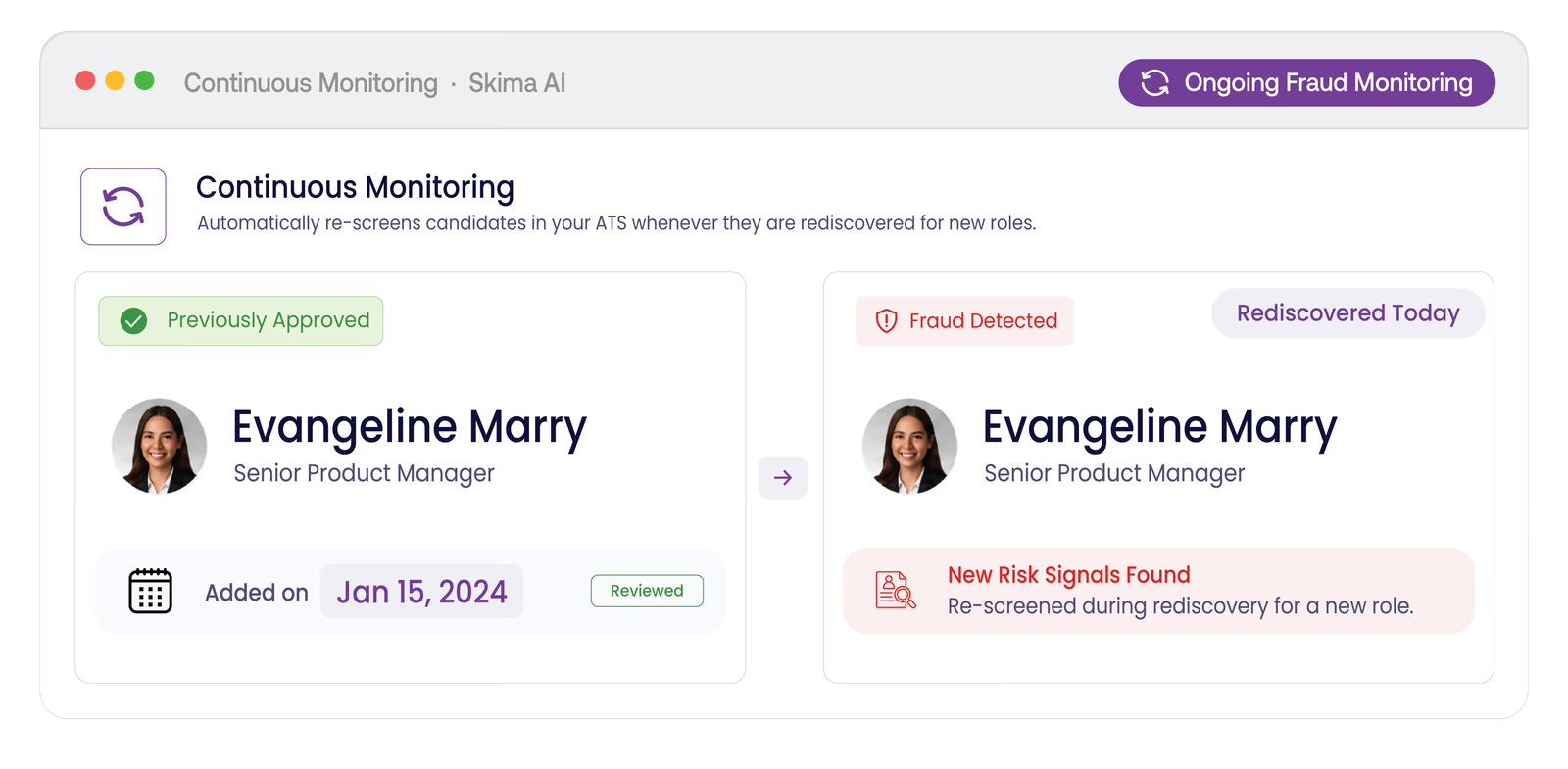
Detecting candidate fraud is not a one-time gate. When candidates in your ATS are rediscovered for new roles months or years later, Skima AI re-screens them against current fraud intelligence. Candidates who were clean at intake can develop risk signals over time. The tool catches what a one-time check cannot.

You are accountable for quality of hire and cost per hire. Every fraudulent placement is a failed hire that damages both metrics. The platform protects the integrity of your pipeline at scale.

One fraudulent candidate placed at a client site can end the relationship. The automated fraud detection engine screens candidates before submission and continuously verifies identity through placement, protecting your revenue and your client's trust.

At scale, manual fraud detection is impossible. Skima AI automates multi-signal analysis across your entire applicant volume, integrates with your ATS, and provides auditable, explainable results that satisfy procurement, legal, and compliance requirements.
The detection signals that matter for a healthcare recruiting team are not the same ones that matter for a tech recruiting team. Skima AI fraud intelligence adapts to the patterns specific to your industry.

Proxy interviews, in-interview AI cheating, AI-generated resumes, inflated technical skills, and resumes engineered to beat ATS keyword screening.

Identity fraud across state lines, fabricated or inflated clinical experience, resume inconsistencies in work history, and AI-generated resumes misrepresenting qualifications.

Employment history fabrication and resume inconsistencies, inflated financial modeling or analytical skills, and AI-generated resumes for compliance-sensitive roles.

Fabricated or inflated project portfolios, skills overstatement on safety-critical roles, and AI-generated resumes misrepresenting technical experience.

Identity duplication across staffing agencies, inflated equipment and certification experience, and resume inconsistencies across multiple applications.

Identity and work-authorization verification, fabricated or inflated government project history, and resumes engineered to pass government contractor ATS screening.
Skima's detection engine evaluates candidates across five signal categories for detecting candidate fraud.

Document authenticity, selfie-to-ID matching, email and phone validation, device fingerprinting, cross-session biometric consistency.

Linguistic pattern analysis to detect AI-generated content, cross-referencing resume claims against LinkedIn and prior application data, file-structure inspection for hidden text and keyword stuffing.

Claimed skills and tools cross-checked against project history, portfolio evidence, and demonstrated technical depth.

Audio-visual sync, lip-sync consistency, gaze and eye-movement patterns, response latency, and screen-sharing anomalies for fake candidate detection in live sessions.

Device and IP reuse across multiple candidate applications, and submission timing patterns inconsistent with genuine individual behavior.
The detection AI does not evaluate protected characteristics. Risk signals are tied exclusively to fraud indicators: identity inconsistencies, behavioral anomalies, resume authorship patterns, and deception patterns.
Skima AI does not make hiring decisions. Every flag is a recommendation for human review, with full transparency into the signals that triggered it. The hiring decision belongs to the recruiter or hiring manager. This is not a design philosophy. It is a compliance requirement, and the product enforces it architecturally.
Among AI tools to prevent recruiting fraud, Skima AI is the only vendor that publishes this level of model transparency on its product page.
Skima AI connects to your ATS through bi-directional sync. Candidate data flows in, fraud signals flow back, directly inside the tools your recruiters already use. No separate dashboard. No workflow disruption.
Bias audit completed and published. All Automated Employment Decision Tool requirements met for automated hiring decisions.
High-risk AI transparency, explainability, and human oversight requirements met. Applies to candidate matching, screening, and JD optimization.
Adverse impact analysis covers every AI decision. Candidate matching, JD optimization, interview question generation, and candidate scoring.
Your candidate data is never used to train models for other customers. Full data isolation between accounts. Your database stays your competitive advantage.
Candidate data encrypted at rest and in transit. Infrastructure audited and certified to SOC 2 Type II standards.
AI recommends, your recruiter decides. Skima AI never auto-rejects a candidate and never auto-advances anyone to an offer.
Skima AI has been a game-changer for our recruiting process. For high-volume roles with hundreds of applicants, we used to experience meaningful delays before engaging some of our highest quality candidates.

Head of People · Robotics Engineering · US · 2026
“Skima AI makes the hiring process more collaborative by giving hiring managers a clear breakdown of each candidate’s pros and cons.”
Director, Talent Acquisition · SambaSafety
Every fraudulent hire that reaches a client, a system, or a team is a preventable loss. See how Skima AI detects fraud across every stage of hiring.
Candidate fraud detection is the use of AI and verification tools to catch deception in hiring, proxy interviews, fabricated resumes, deepfakes, and identity fraud before a bad hire happens. It analyzes identity, resume authenticity, and interview behavior, flagging risk for human review rather than deciding outcomes.
You can prevent candidate fraud by verifying identity when candidates apply, cross-checking resume claims against LinkedIn and employment history, and monitoring interviews for proxy substitution or AI-assisted cheating. Automated fraud detection tools like Skima AI help detect issues that manual screening may miss, flagging risk signals before a recruiter invests time in a candidate who isn’t the person they claim to be.
Look for inconsistent dates, inflated titles, and claims that contradict LinkedIn or prior applications. Check for AI-generated phrasing, hidden keywords, and unverifiable project history. Pair manual review with automated resume fraud detection that cross-references claims against real data instead of trusting the document at face value.
Use identity verification before the call, monitor for virtual cameras and screen-sharing anomalies during it, and track gaze patterns and response latency that suggest hidden notes or AI assistance. Continuous verification, not a one-time check, can help detect substitution and cheating in distributed, outsourced hiring.
The best practices for detecting candidate fraud in remote hiring include verifying identity before every interview, screening resumes for fabrication and inconsistency, monitoring live sessions for deepfakes and proxy behavior, and re-screening candidates on rediscovery. Keep humans in the review loop. Remote hiring removes physical presence, so detection has to replace what in-person interviews once caught.
Yes, when the system is designed for compliance. Skima AI supports FCRA-compliant workflows, meets EU AI Act requirements for human-in-the-loop oversight, and exceeds NYC Local Law 144 bias audit requirements.
Yes, unlike tools that only screen new applicants at intake, Skima AI re-screens candidates when they are rediscovered for new roles, catching fraud signals that may have emerged since the candidate first entered your ATS.
No, Skima AI flags candidates for human review. It never auto-rejects. The recruiter or hiring manager makes the final decision with full context. This is enforced architecturally, not left to policy.