




















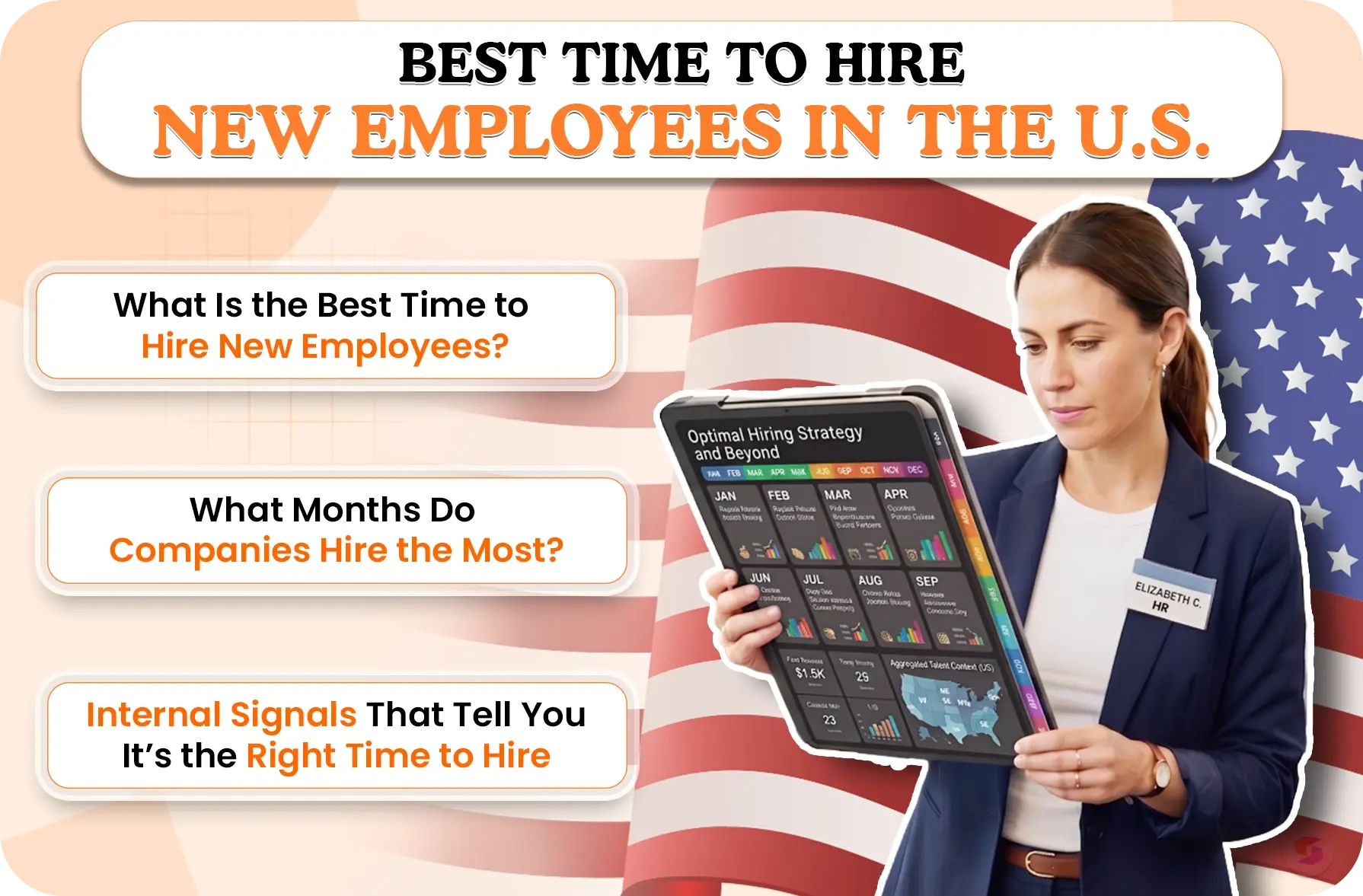
- The best time to hire new employees is January–February, with another strong window in September–October due to high budgets and candidate activity.
- Hiring success depends on both market timing and internal readiness, including revenue coverage, clear role definition, and manager availability for onboarding.
- Use slow hiring months like July and December to build talent pipelines, so you are ready to hire quickly during peak periods.
- Plan hiring timelines in advance (8–16+ weeks depending on role) and align headcount decisions with revenue milestones and finance approvals.
- Avoid reactive hiring, slow decision-making, and poor timing, as these mistakes reduce access to top candidates even during the best time to hire new employees.
Hiring patterns vary throughout the year. In the U.S., peak periods typically occur in January-February and September-October, with spring also being active. This is primarily due to budget resets, leaders opening new headcount, and increased job seeker activity.
This guide breaks down the best time to hire new employees based on real data, U.S. labor trends, and seasonal patterns. Whether you're scaling a team, backfilling a role, or planning annual headcount, this will help you hire smarter, not just faster.
What Is the Best Time to Hire New Employees?
The best time to hire new employees is January and February. This period is the best because job seekers are motivated by New Year goals, and teams are working with fresh annual recruiting budgets.
For example, February 2026 saw 6.9 million job openings and 4.8 million hires, highlighting that hiring remains significant despite market fluctuations.
That said, there is no single best month for every role. The right time also depends on whether you are filling a growth role, replacing a departure, or hiring for a seasonal spike. A good hiring strategy starts with timing, but it succeeds because the process is ready when the role opens.
What Months Do Companies Hire the Most?
Most hiring activity in the U.S. follows a predictable pattern. It's driven by budget cycles, fiscal year resets, and the natural rhythm of business decision-making.
Here's what the calendar actually looks like:
Q1 is the strongest hiring period, with LinkedIn data showing January and February as peak months for job postings. New budgets and headcount approvals drive this trend, as candidates return from holiday breaks.
The second peak occurs from September to October, influenced by mid-year reviews. Although July and December are calmer, they present opportunities for reaching passive candidates with less competition.
Best Time to Hire Contract Staff
The best time to hire contract staff is before demand peaks, ideally 4 to 8 weeks in advance. Early planning allows for a broader candidate pool and smoother onboarding.
Contract hiring is most effective for temporary needs, such as holiday support, project launches, or short-term operational surges.
While speed is crucial, having clear job definitions and efficient screening is vital. Additionally, tools like Skima AI can streamline candidate management and automate processes when hiring volumes increase.
Internal Signals That Tell You It’s the Right Time to Hire
The calendar tells you when the market is ready. The following signals will tell you when your company is ready:
1. Revenue Coverage is Sufficient
The total cost of the role, including salary, benefits, and overhead, should be supported by existing or contracted revenue, with some margin for comfort. A common standard is that the projected 12-month revenue should exceed the hire's cost by at least a factor of 1.5.
2. The Bottleneck is Human, Not Process
If your growth is stalling due to a lack of personnel, it’s time to hire. However, if the slowdown stems from ineffective workflows, prioritise fixing those first. Hiring into a flawed system often leads to frustrated and costly employees.
3. Manager Bandwidth for Onboarding is Present
New hires need dedicated attention during their first 30-60 days. If the hiring manager is busy with product launches, frequent travel, or team crises, consider delaying the start date. Inadequate onboarding can result in losing the hire within 90 days.
4. The Role is Clearly Defined
A vague job description can lead to mis-hires. Before advertising, the hiring manager should answer: What does success look like in 90 days? If this clarity is absent, the role isn’t ready.
5. You're Anticipating a Departure
If an employee has submitted notice or appears to be seeking new opportunities, begin backfilling 6-8 weeks before their departure. Reactive hiring usually results in poorer outcomes than proactive approaches.
How to Build a 12-Month Hiring Plan?
Our experts have developed a structured 5-step plan to help you recruit the top 1% of talent throughout the year:
Step 1: Map Revenue Milestones to Headcount Triggers
Each significant revenue or contract threshold should link to a role being unlocked. Remove bias from the process. When X occurs, Y position opens.
Step 2: Work Backwards from Target Start Dates
For mid-level roles, allow 8-10 weeks from job posting to offer acceptance. Senior roles require 12-16 weeks, while executive hires need 4-6 months. Plan accordingly.
Step 3: Create Four Quarterly Hiring Windows
Align your approvals, job description preparation, and kickoffs around February, May, August, and November. Predictable pipelines consistently outperform reactive ones.
Step 4: Use Slow Months to Build Your Talent Bench
July and December are ideal for sourcing rather than closing. Conduct searches, engage passive candidates, and create talent pools.
Tools like Skima AI ease this process, as its AI candidate matching and resume search capabilities help keep the pipeline warm before hiring windows open. This preparation ensures you’re not starting from scratch when Q1 or Q3 arrives.
Step 5: Align with Finance on a Headcount Release Calendar
The primary reason for delayed hires in mid-market companies is often misalignment between HR and Finance regarding headcount approval timelines. Establish dates on the calendar in advance rather than in real-time.
5 Common Mistakes Companies Make
Even with the right timing, teams trip up on the same avoidable errors. Here are 5 of them:
- Waiting for a Vacancy Before Sourcing: Reactive hiring often costs you top candidates. Build talent pipelines continuously, not just when positions are vacant.
- Posting at the Wrong Time of Year: Listing a senior role in July or December and expecting quick results is unrealistic. Align your posting schedule with when your target candidates are searching.
- Moving Too Slowly During Peak Season: In January–February, a two-week gap between interviews can lead to losing a candidate. Speed is crucial when competition is highest.
- Ignoring Industry-Specific Cycles: A healthcare system hiring nurses and a SaaS company hiring engineers follow different seasonal patterns. Use data specific to your sector.
- Treating All Roles Identically: An entry-level SDR and a VP of Engineering need different timelines and sourcing strategies. Using the same approach for both wastes time.
Summary
The best time to hire new employees in the U.S. is usually January-February and September-October, with spring also offering strong activity. For contract staff, the smartest move is to plan 4 to 8 weeks ahead of the demand spike.
In a market where hiring is still difficult and the average time to fill is over a month, timing matters as much as process.
For leaders, the takeaway is simple: do not hire late, blindly, or wait for a perfect month. Build the pipeline early, move fast, and match hiring speed to business urgency. That is where the strongest teams win.
Frequently Asked Questions
1. When is the hiring season in the U.S.?
Hiring season usually starts in January, picks up again in spring, and returns in September and October. Late November through December is typically slower because holidays disrupt approvals, interviews, and onboarding.
2. When do companies hire most?
Most companies hire most in January, February, September, and October. Those months usually bring fresher budgets, stronger candidate activity, and more urgency to fill approved roles before the year shifts.
3. When does the hiring season start?
For many U.S. employers, hiring season starts right after New Year planning when budgets open and managers restart requisitions. Some industries begin earlier if they need seasonal or project-based staff.
4. What is the best time to hire contract staff?
The best time to hire contract staff is 4 to 8 weeks before the workload spike. That gives teams time to source, screen, and onboard without scrambling at the last minute.
5. Which months are best for hiring new employees?
January and February are the strongest months overall, while spring and early fall are also productive. Use slower months to source talent, refine interviews, and prepare openings for the next peak.