





















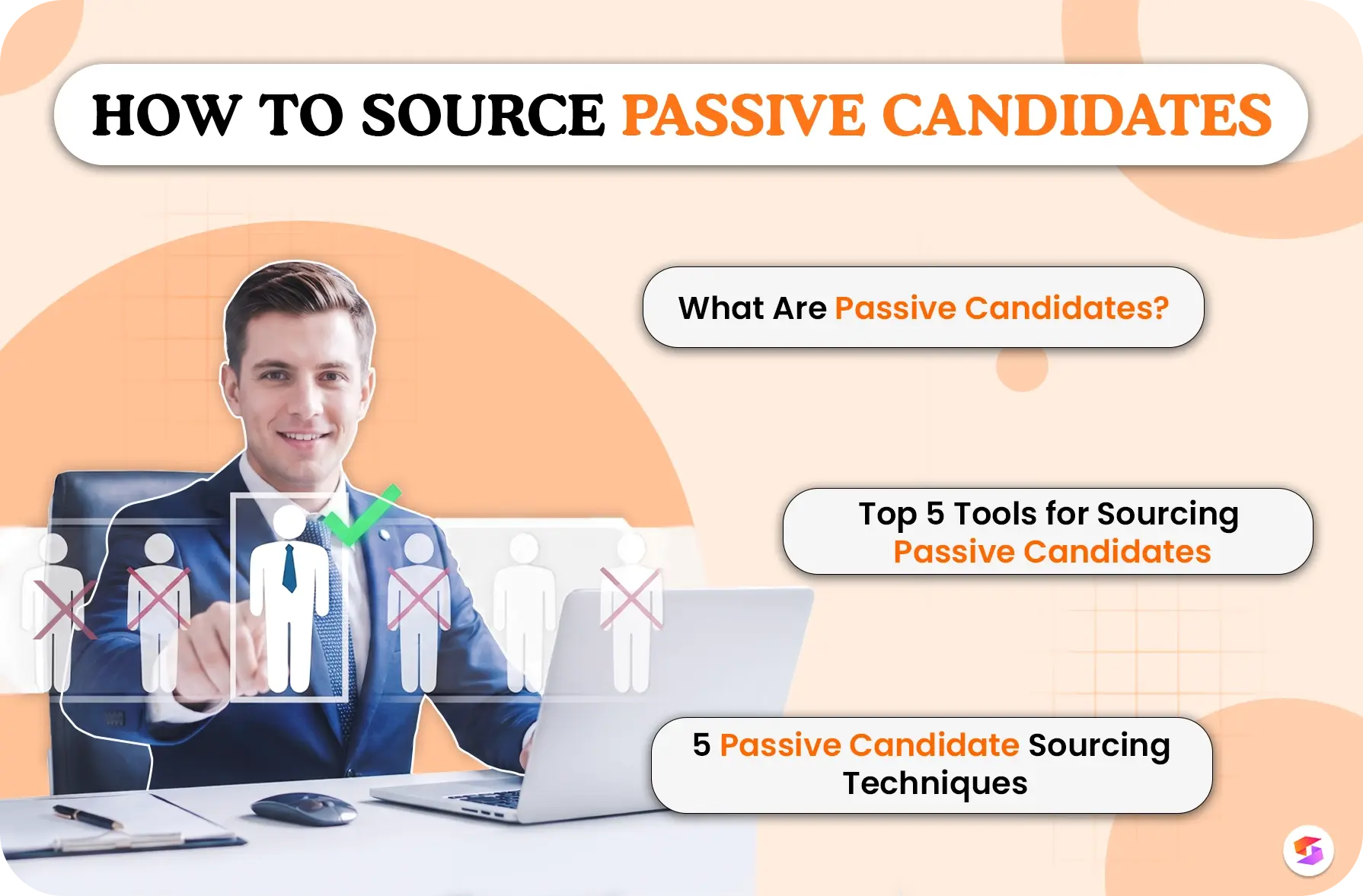
Here are the 5-step process, tools, and techniques to source passive candidates effectively:
- Define the ideal candidate profile in passive candidate sourcing to target the right talent based on skills, outcomes, and experience.
- Map sourcing channels in passive candidate sourcing to identify where passive candidates are active beyond job boards.
- Use AI tools like Skima AI in passive candidate sourcing to scale efforts by quickly identifying and matching high-quality candidates.
- Personalize outreach in passive candidate sourcing to increase engagement and improve response rates.
- Nurture a talent pipeline in passive candidate sourcing to build a long-term system that speeds up future hiring.
70% of the global workforce isn’t actively seeking new jobs. As a result, the ideal candidates for your roles are likely not on job boards. They’re busy excelling in their current positions as passive candidates.
If you focus only on the 30% who are job hunting, you’re missing out. The competition for these individuals is intense, with 250 applications per posting, often from unsuitable candidates.
This guide walks through a 5-step process on how to source passive candidates for identification and engagement, including 5 tools, response-boosting techniques, and the mistakes that silently kill your outreach.
What Are Passive Candidates?
A passive candidate is a working professional who isn't actively job hunting, but is open to the right opportunity. They aren't submitting their resumes or searching job boards, yet they're still visible to recruiters.
They maintain a professional presence by attending industry events, publishing content, and updating their LinkedIn profiles. Notably, 94% of passive talent are open to job offers when approached, revealing their need for strong reasons to switch careers.
How to Source Passive Candidates: 5-Step Process
The passive candidate sourcing is a repeatable system, not a one-off LinkedIn search. Below is a practical 5-step process you can run for almost any role:
Step 1: Define Ideal Candidate Profile
Align with the hiring manager on success criteria for the role over the next 6-12 months. Translate this into essential skills, desirable skills, and context, focusing on candidates capable of performing the work.
Key actions:
- Co-create a success profile with the hiring manager (outcomes, metrics, and responsibilities).
- Convert that into a shortlist of core skills, tools, and domain experience.
- List target and “lookalike” companies where these people are likely to be found.
Insight: This clarity helps your team focus on finding the right candidates. It stops them from pursuing profiles that don’t truly fit the role.
Step 2: Map Your Sourcing Channels
Identify where your ideal passive candidates are active. They may not be on job boards but are likely in your ATS, on professional networks, inside niche communities, or building portfolios on specialized platforms.
Key actions:
- Your existing ATS and CRM (silver medalists, past applicants, and talent communities). Start with Skima AI's database rediscovery.
- LinkedIn and LinkedIn Recruiter for advanced search and relationship building.
- Specialized platforms like GitHub, Dribbble, Reddit, and industry-specific forums.
- Alumni networks, conferences, and online communities where your ideal candidates share insights.
Insight: Recent studies show that engaging niche communities and leveraging existing recruitment databases effectively uncover high-quality passive talent.
Step 3: Use AI and Sourcing Tools
Manual sourcing struggles to scale with numerous open roles. AI tools can quickly scan millions of profiles, enhancing recruitment speed and achieving accuracy. This enables recruiters to prioritize outreach and create precise shortlists.
Key actions:
- Upload and cleanse your existing candidate database; let AI find matches you’ve forgotten.
- Run targeted searches across global and local datasets with filters for skills, location, experience level, and more.
- Combine Boolean and semantic search (e.g., matching “machine learning engineer” with “ML scientist” or “data scientist”) to avoid missing strong fits.
Insight: When executed well, teams report cutting time-to-fill from industry benchmarks of more than 60 days down to a few weeks for priority roles.
Step 4: Engage Relevant Outreach
Sourcing passive candidates is only the beginning; true success demands genuine engagement. Since passive candidates aren't obligated to reply to noisy inboxes, outreach must be concise, specific, and relevant to their career goals.
Key actions:
- Keep first messages under 300-400 characters, or 3-5 tight sentences.
- Reference something specific (a project, talk, open-source repo, or career move) to prove you’ve done your homework.
- Lead with what matters: flexibility, impact, growth path, or tech stack, based on what similar passive candidates say they value.
- Offer a low-pressure next step, like a 15-minute intro chat, rather than pushing a full interview upfront.
Insight: Recruiters who tailor their outreach with behavioral insights and utilize multi-channel strategies consistently receive more responses than those using generic templates.
Step 5: Nurture a Passive Pipeline and Employer Brand
Not all passive candidates engage immediately. Build a warm talent pipeline by ensuring they know your brand and mission. Your employer reputation, visibility on your careers site, and social media heavily influence their response.
Key actions:
- Tag and segment passive candidates inside your ATS or sourcing tool by skill, seniority, and interest level.
- Share relevant content (e.g., case studies, engineering blogs, leadership posts) periodically to stay top of mind.
Insight: Over time, this turns sourcing passive candidates into a system where every new role starts with a warm list, not a cold search.
Top 5 Tools to Find Passive Candidates
The right tools turn passive sourcing from a grind into a scalable system. Here are the 5 platforms worth considering for sourcing passive candidates:
1. Skima AI
Skima AI is an AI recruitment platform that helps you find passive candidates faster than manual processes. It works by integrating LinkedIn, job boards, and other tools. Its AI sourcing engine identifies qualified candidates across channels in under 48 hours, while the industry average is 2-3 weeks.
Key sourcing benefits:
- Scans millions of profiles and resumes for quick results.
- Generates AI scores with reasoning and highlights skill insights effectively.
- Verifies skills listed on resumes with real experience.
- Tags candidates across meaningful dimensions, beyond keywords.
- Automates outreach campaigns, engaging passive candidates effortlessly.
- Reduced sourcing costs by 28% and hiring time by 67%.
2. LinkedIn Recruiter
LinkedIn Recruiter is the leading sourcing platform, offering access to over 700 million professionals. It is essential for finding passive candidates, particularly for corporate and mid-senior positions.
With advanced filters, AI recommendations, and InMail messaging, it serves as the primary tool for various recruiting workflows.
Key benefits and use cases:
- Full network access beyond first and second-degree connections.
- Advanced filters for title, company, location, seniority, skills, and education.
- AI-recommended candidates based on your previous searches and hiring patterns.
- InMail messaging with response tracking and performance analytics.
- Team collaboration tools to share profiles and coordinate across hiring stakeholders.
3. hireEZ (formerly Hiretual)
hireEZ is an outbound recruiting platform that consolidates candidate data from over 45 sources, including GitHub and Stack Overflow, into one interface. It excels in sourcing for technical and specialized roles beyond LinkedIn.
Its AI detects passive candidates through behavioral signals, while its drip campaign feature facilitates automated outreach sequences.
Key benefits and use cases:
- Multi-source candidate aggregation across 45+ professional networks and databases.
- AI-powered passive candidate identification based on career signals and engagement patterns.
- Built-in drip campaign feature for structured passive candidate nurturing over time.
- DEI sourcing filters to support diversity hiring goals and underrepresented talent pipelines.
- Native integrations with major ATS platforms like Bullhorn, Workday, and Salesforce.
4. SeekOut
SeekOut is a talent intelligence platform designed for hard-to-fill and diversity-focused hiring. It aggregates data from GitHub, academic databases, patents, publications, and LinkedIn, offering recruiters a comprehensive view of technical and niche candidates.
For teams hiring engineers, researchers, or specialists, SeekOut delivers insights that surpass what LinkedIn can offer.
Key benefits and use cases:
- Deep candidate profiles combining GitHub contributions, patents, publications, and professional data.
- Diversity filters to identify and engage underrepresented talent proactively and systematically.
- Advanced Boolean and AI search built specifically for technical and specialist role types.
- Internal mobility features to surface high-potential employees for new or evolving roles.
- Talent market analytics to benchmark hiring difficulty and compensation in real time.
5. Gem
Gem is a talent CRM and sourcing platform that integrates with LinkedIn and your ATS. It creates a structured, measurable workflow for passive candidate outreach. It builds long-term talent pipelines, tracks interactions, and automates outreach sequences.
Key benefits and use cases:
- CRM-style pipeline management to nurture passive candidates across months and quarters.
- Automated multi-step email sequences with personalization at scale using LinkedIn data.
- End-to-end tracking from first touchpoint to hired, with full sourcing attribution.
- Sourcing analytics to measure response rates, conversion rates, and source-of-hire ROI.
- ATS sync to ensure no candidate falls through the cracks between sourcing and active hiring.
Why Passive Candidate Sourcing Matters?
Passive candidate sourcing is essential, as job boards typically attract only those actively seeking employment. Recruiters now must proactively source candidates, as traditional job advertisements are no longer sufficient.
Below are 5 reasons why passive sourcing has moved from "nice to have" to a core strategic hiring function:
1. Shrinking Talent Pool
Skill shortages in tech, healthcare, engineering, and finance mean that relying on qualified inbound applications leads to long waits, often for candidates who do not completely fit your requirements.
2. Prove Better Hires
Passive candidates tend to be higher quality. Their interest in your job often indicates genuine enthusiasm. Without a compelling reason to leave their current role, this motivation enhances retention and performance.
3. Improved Retention
Passive candidates who accept positions do so with clear motivation, having carefully weighed the opportunity against their current stability, leading to a stronger intent to contribute and better long-term retention than pressured hires.
4. Pipeline Enhances Time-to-fill
Active pipeline management reduces time-to-fill by 30% annually. Companies with warm passive candidate pipelines benefit from pre-qualified candidates. While 58% of large employers use AI for sourcing, many still depend on job postings.
5. Growth In Employer Brand
Building relationships with passive candidates positions your company as their first choice when they decide to move, eliminating the need for job postings, frantic recruiter efforts, and competing with multiple offers.
5 Passive Candidate Sourcing Techniques
Below are 5 effective techniques backed by recent recruiting research and best practices, each fitting seamlessly into the five-step process outlined above:
1. Hyper-Personalized, AI-Driven Talent Intelligence
Employ AI to assess candidates' entire professional backgrounds, projects, skills, and shared content. Personalize your outreach with specific details to improve response rates; tailored messages convert 2-3 times better than generic ones.
2. Leverage Employee Referrals with Incentives
Your team understands your culture. Create a structured referral program with clear rewards and regularly communicate open roles. Hiring managers favor referrals, leading to better candidates who integrate quickly. Track submissions effortlessly.
3. Data-Driven Sourcing from Internal Databases
Utilize your ATS to find “silver medalists,” former applicants, and archived profiles. AI can match these candidates to new roles, potentially filling 30-40% of positions without needing external searches, according to sourcing benchmarks.
4. Social Media Intelligence Beyond LinkedIn
Explore Twitter, Reddit, GitHub, and industry groups to find active contributors. Start conversations to establish rapport. These platforms showcase skills often overlooked in resumes and indicate high-performing individuals through community involvement.
5. Talent Mapping and Market Insights
Identify target companies and leverage salary benchmarks and skill availability data to prioritize outreach. Monitor metrics such as response rates by channel to enhance strategies, leading to 20-30% improved conversions over time.
5 Common Mistakes in Recruiting Passive Candidates
Low passive candidate engagement often stems from recurring mistakes. Here are five key issues, backed by research, and practical solutions to improve results:
Summary
Passive candidate sourcing is vital for competitiveness. With 70% of the global workforce not actively seeking jobs, top talent receives less but more impactful recruiter outreach. Successful companies focus on proactive, relationship-based sourcing.
To make this shift, define a clear candidate profile, choose a few relevant channels, employ effective tools, and nurture relationships before a need arises. Recruiters who excel in passive sourcing not only fill roles faster but also improve overall hiring quality.
Frequently Asked Questions
1. What is a passive job seeker?
A passive job seeker is someone who is currently employed or not actively applying, but may consider a better role if the opportunity offers stronger pay, growth, culture, or flexibility.
2. How do you source passive candidates?
You source passive candidates by using LinkedIn, referrals, talent communities, Boolean searches, and direct outreach. The key is to target the right people and personalize every message.
3. How to engage passive candidates?
Engage passive candidates by leading with relevance, not pressure. Show why the role fits their background, keep the message short, and follow up with useful context or value.
4. How to source candidates as a recruiter?
As a recruiter, sourcing candidates by building a clear ideal profile, searching multiple channels, tracking prospects in a talent pipeline, and using structured outreach to turn interest into conversations.
5. How to attract passive candidates?
Attract passive candidates with a strong employer brand, meaningful career opportunities, competitive compensation, and outreach that feels personal, credible, and low-pressure. Respect their time and interest level.